A few months ago I watched a film called ‘The Electrical Life of Louis Wain’. It’s a sad, but at the same time very life-affirming story of the British artist who created pictures of cats. The film stars Benedict Cumberbatch, and it also features Nick Cave as H. G. Wells in the final scenes. Interestingly, the musician said in an interview that he has been a fan of Louis Wain for several decades, despite the fact that the artist is relatively unknown. Some of his pictures, shown on full screen with the end credits, look as if they were created in the 1960s rather than by an artist born and raised during the Victorian age. Speaking of H. G. Wells, the writer prophesied a number of later inventions in his science fiction works and is said to have used ‘commonplace detail alongside a single extraordinary assumption per work’ to make it realistic. I remember borrowing his 1895 novel ‘The Time Machine’ from the University of Westminster library and reading it in my tiny room in the halls of residence located in London Victoria. The effect was intensified by the realisation that Battersea and Wandsworth, some of the actual places described in the book, were just a few miles away.
As for the word ‘electric’, it can often be found in a metaphorical meaning in English, particularly in poems and songs. It was used by the nineteenth-century American author Walt Whitman in the poem ‘I Sing the Body Electric’, which originally appeared in his 1855 collection ‘Leaves of Grass’ without a title. Just like Wain and Wells, Whitman seems to have been way ahead of his time, and a lot of his work still feels bold and innovative. And the other day I listened to Coldplay’s new album and discovered that the very first song, ‘Higher Power’, contains the word ‘electric’ too, while the last one, ‘Coloratura’, uses an electronic musical instrument called theremin, which features prominently in the soundtrack of ‘The Electrical Life of Louis Wain’! Isn’t it curious how life is pierced with invisible connections? As Chris Martin sings in the beautiful and uplifting ‘Coloratura’, ‘And up there in the heavens / Galileo saw reflections of us too / Pluribus unum, unus mundus’. Speaking of Galileo, his bas-relief portrait can be found on the façade of the Russian State Library together with those of other great thinkers of different times. Incidentally, it’s a place I’ve been around a lot in the last few days.
22/01/2022
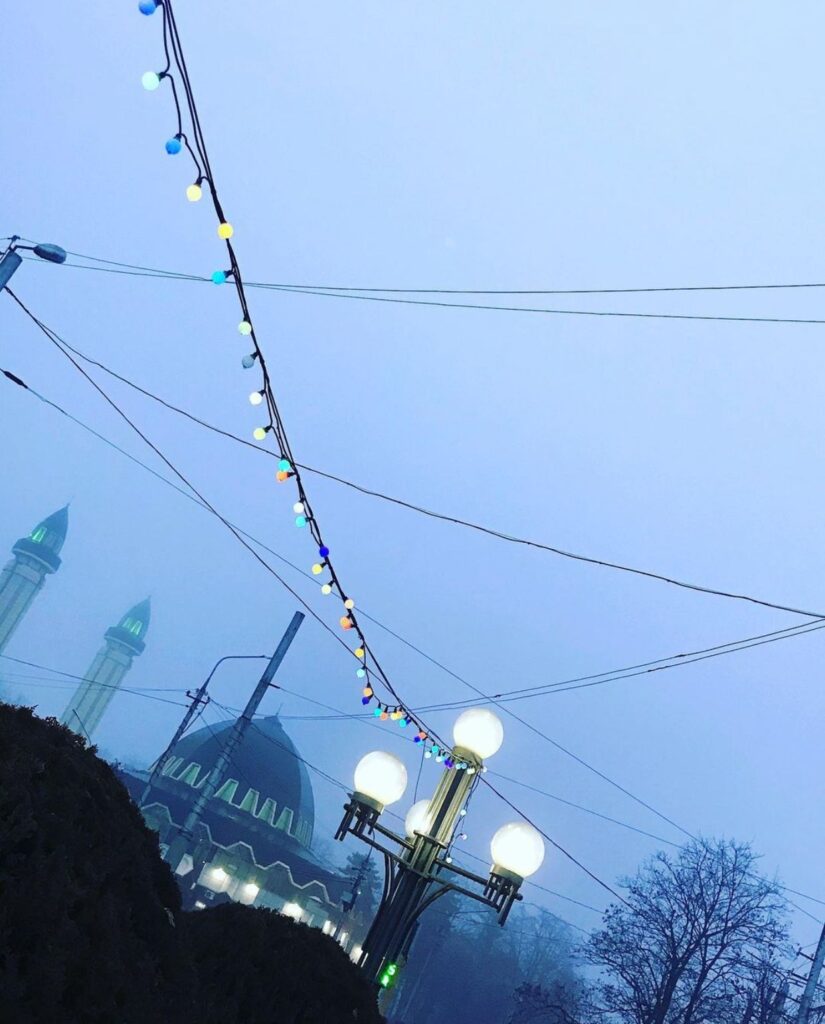
/Photo taken by my soulsister in Nalchik, Russia/